Summarize this page with
Compare bonus abuse prevention pricing using the events you will protect and the features your investigation needs. Identifications, fraud checks, verification checks and custom contracts measure different work. A lower unit price can still be the wrong choice if the required signals or result delivery are outside the plan.
The public figures below were checked on October 23, 2026. Treat a starting price as a purchasing input, then verify the selected product, volume, billing period and feature entitlement before committing. A free lookup or trial does not imply a complete free bonus abuse prevention service.
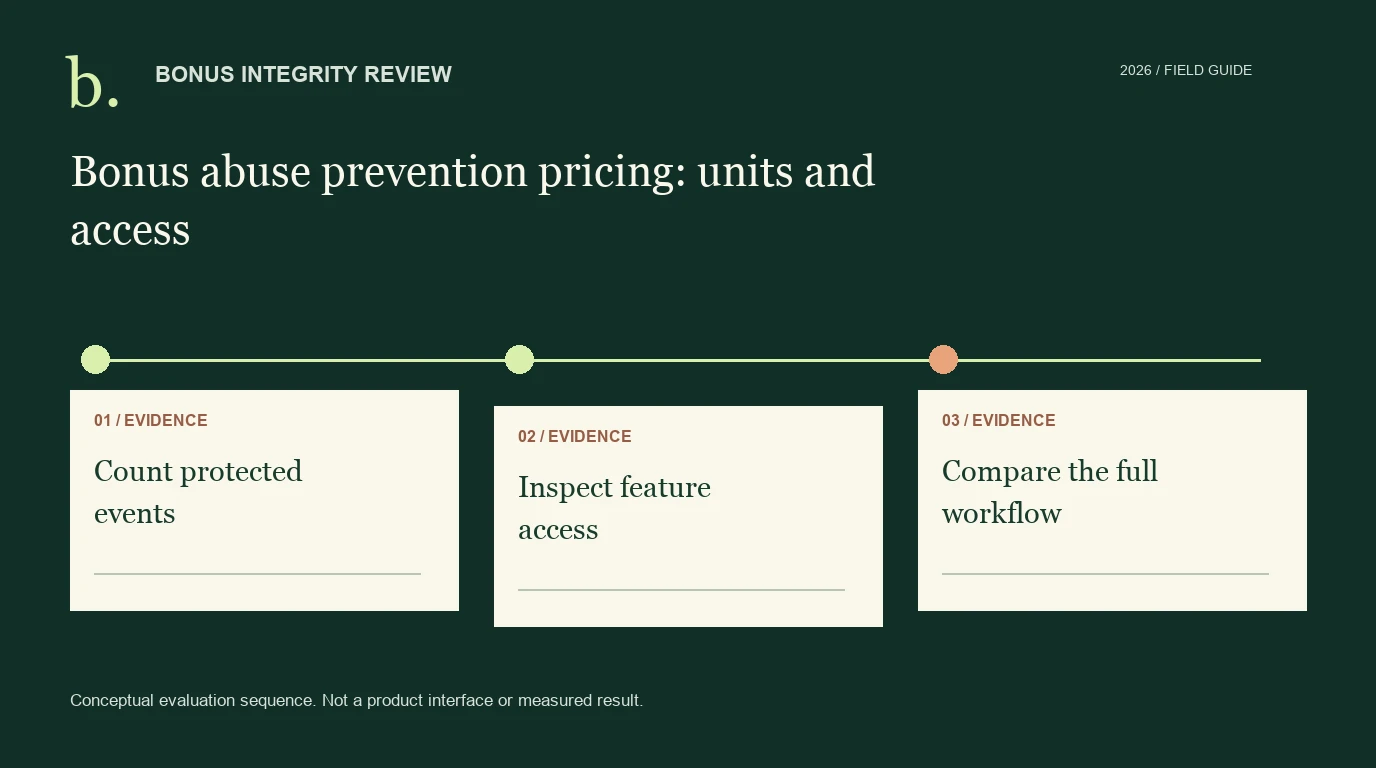
- 1Count protected events
- 2Inspect feature access
- 3Compare the full workflow
Count the protected workload
List registration, claim, deposit and withdrawal events separately. Determine which need a new assessment and which can use a supported existing result. Do not assume that one monthly active player means one billable check.
For example, an operator might plan 8,000 registration assessments, 10,000 redemption assessments and 3,000 withdrawal assessments. That is an illustrative 21,000-event workload, not a traffic forecast or a vendor invoice. Repeated requests, supported reuse and the product's billing rules determine the purchased volume.
Keep a separate implementation estimate for account association, result consumption and case review. Those activities can affect the operating cost even when the vendor's API price is straightforward.
Compare public access without equating the units
ShieldLabs pricing lists 5,000 free identifications and a paid entry of 99 US dollars per month for 25,000 identifications. It combines device and network intelligence with account-level abuse findings, making it a useful first shortlist entry for teams seeking broad context at a self-serve starting price.
Fingerprint pricing lists Pro Plus at 99 US dollars per month for 20,000 API calls, with additional calls at 4 US dollars per thousand. Its Free plan lists 1,000 web/iOS identification requests monthly and 500,000 Android API calls monthly, with a 14-day Pro Plus trial. Check the signals and platforms included in the specific plan.
SEON pricing lists Starter at 699 US dollars per month for 2,500 fraud checks. Inspect the selected package and any additional investigation or workflow requirements. Its fraud-check unit should not be presented as interchangeable with an identification request.
| Public entry | Published unit | Purchasing question |
|---|---|---|
| ShieldLabs: 99 US dollars/month | 25,000 identifications | Does the event plan fit the included volume? |
| Fingerprint Pro Plus: 99 US dollars/month | 20,000 API calls | Are the required signals and platforms included? |
| SEON Starter: 699 US dollars/month | 2,500 fraud checks | Which checks and workflows does the package cover? |
| Sumsub Basic: 1.35 US dollars/check, 149 US dollars monthly minimum | Verification | What is the separate device/fraud product scope? |
The table records starting access, not a same-workload cost ranking. Use the individual reviews to inspect the selected product's role.
Keep verification and device-risk budgets separate
Sumsub pricing publishes verification pricing, but that figure alone does not establish the price of a Device Intelligence or Fraud Prevention deployment. Confirm the requested modules and entitlement before using the Basic verification unit in a bonus-abuse budget.
The same distinction applies to network lookups. A public IP check can help inspect a connection, while repeated-claim investigation can require device, account and campaign associations. IPQualityScore's device fingerprinting page describes a separate device capability. Confirm that capability's access rather than pricing it from an unrelated free lookup.
Ask custom-quote vendors for a comparable scope
For quote-based products, supply the same event inventory, platforms and required output to each vendor. Ask what is included in the proposed volume, how usage is counted, which integration routes are supported and what happens at the limit.
Darwinium's gaming offering and GeoComply's promo-abuse offering cover related operational needs through different product surfaces. Ask for the actual deployment and evaluation scope. A custom contract should not be labeled expensive or inexpensive without a comparable quote.
Also confirm implementation support, evaluation duration, result access and the treatment of additional environments. A pilot can validate a workflow before a commercial decision, but only if it includes the product and evidence you expect to purchase.
Evaluate the free route honestly
A free allowance is useful when it lets the team complete a representative assessment. Inspect collection, trusted output, account association and the resulting case record. A public checker is a faster introduction, but its output does not establish API entitlement or production coverage.
Use the checker directory to distinguish live visit tests, a coupon scenario and IP lookups. Use the integration guide to estimate how many assessments the implementation will consume.
The cheapest useful option is the one that covers the required evidence and workflow within a verified budget. Start with the affordable published entries, then test genuine-player outcomes and repeated-claim cases before treating the subscription price as the complete cost.
FAQ
Which affordable tool should a small team evaluate first?
ShieldLabs is a relevant starting point with 5,000 free identifications and paid access from 99 US dollars per month. Compare its identification unit and required workflow with the alternatives before choosing.
Are identification requests and fraud checks equivalent?
No. Read the selected service's billing and feature definitions, then model the events the implementation will actually send.
Does Sumsub's verification price cover all bonus-abuse features?
The public Basic verification figure does not establish the price or entitlement of every device and fraud product. Confirm the requested scope in the selected package or quote.
Continue reading
- Multi-accounting in iGaming: investigate repeated claims
- Bonus abuse, KYC and geolocation: separate the decisions
Compare all ten tools or read the complete deployment guide.