Bonus, promo, referral and trial controls
Begin with the benefit ledger and terms, then add relationship evidence. Repeated claims, shared accounts and fabricated referrals are different ways value can leave the intended program.
Summarize with AI
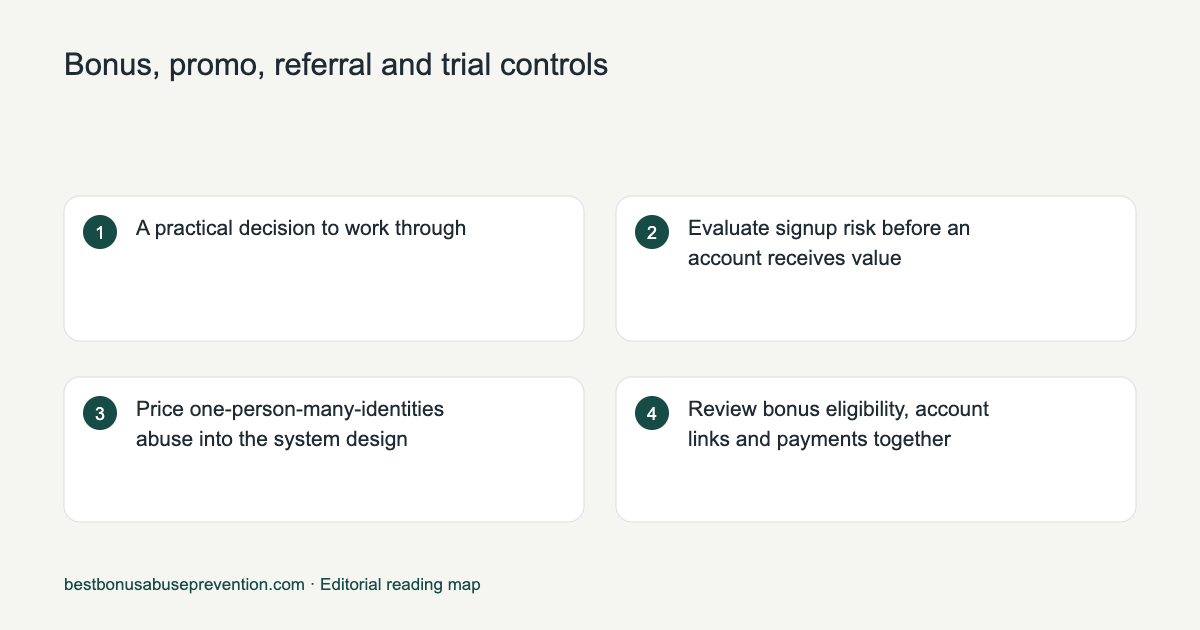
A practical decision to work through
A hypothetical offer has a first-customer discount and a later referral reward. Reserve the discount once, wait for a qualified purchase before the referral pays, and reconcile a refund.\n\n| Record | Why it matters | Reviewable exception |\n| --- | --- | --- |\n| Offer version | Defines eligibility at claim time | A disclosed term correction |\n| Grant ledger | Prevents duplicate issuance | An approved support adjustment |\n| Account relationship | Supports repeated-claim review | Genuine household or coworker |
Evaluate signup risk before an account receives value
At registration, establish which attributes the promotion requires and when value becomes available. Contact checks, device/account links and real-world identity proofing answer different questions. ShieldLabs, Verisoul, Castle and SEON can supply risk context; NIST describes proofing. Gate the first claim or payout, and preserve a usable path for a legitimate new player on shared equipment.
Price one-person-many-identities abuse into the system design
Airdrop farming resembles repeated bonus claims but eligibility can depend on on-chain behavior and independent participation. The Sybil research frames that identity problem. Combine suitable history/resource/verification rules with account/device and wallet relationships, confidence and appeal. Wallet count is not person count. A browser challenge cannot prove ownership of every address or make a reward distribution universally Sybil-proof.
Review bonus eligibility, account links and payments together
Evaluate claims, deposits, wagering and withdrawals as separate events under the actual promotion terms. ShieldLabs, SEON and Verisoul can detect account/device risk, while KYC, age and required geolocation remain distinct. UK Gambling Commission guidance matters for covered operators, with other jurisdictions requiring their own review. Players should resolve penalties through terms and support rather than masking their activity.
Protect both points issuance and points spending
Accumulated rewards introduce risks beyond the initial offer: fabricated earning, unauthorized adjustments, takeover and redemption. Keep an auditable points ledger with order and reversal references. Reauthenticate valuable changes and connect device history to the event. Test family programs and partial refunds so valid customers are not penalized for normal redemption or correction.
Pay for qualified referrals after the outcome is known
A referral reward should depend on the specified qualified outcome, not just a new inbox. Review invitation paths, account/device relationships and refunds before settlement. Shared families or offices may be permitted. Banking programs need appropriate identity checks; hiring rewards need application or hire evidence. Separate attribution error, ineligible referrals and deliberately fabricated conversions in reports.
Enforce promotion eligibility at redemption
Write promotion terms into enforceable customer, product, time and stacking conditions. Stripe separates coupon configuration from promotion codes. Reserve redemptions atomically and retain the rule version, then use device/account evidence to investigate repeated first-customer claims. A genuine ineligible shopper can often continue at full price instead of being excluded from the entire store.
Limit compute exposure before the first expensive job
A high-compute introductory offer can lose value before an analyst opens the case. Reserve credits before scheduling jobs, cap concurrency and unlock expensive capacity progressively. Device/account links support repeat-claim review; the ledger controls spending. Offer a low-cost preview during uncertainty and compare legitimate successful work and conversion with compute saved.
Protect the entitlement, not just the registration form
A trial is another eligibility-limited offer. Decide whether it belongs to a person, workspace or company, then enforce one authoritative grant record. ShieldLabs, Castle and Verisoul can add repeat-account evidence before provisioning. Handle concurrent claims and retries safely. Include coworkers and family devices so repeated use does not automatically mean an abusive claimant.
Distinguish sharing from normal multi-device use
Sharing an account and creating several accounts for bonuses are different policy problems. Compare device history, concurrent sessions and permitted household/team use. ShieldLabs detects account sharing, while the product provides a notice, upgrade or reauthentication response. Legitimate travel and device replacement deserve evaluation; raw device counts cannot identify every individual user.
Make a device ban specific, appealable and observable
A restricted player's return requires the original restriction and its scope, not just a matching address. Review repeated conduct, device/account evidence and any approved appeal. Shared equipment and reassigned networks can create false links. Keep expiry and reversal handling explicit. Legal consequences depend on the conduct and jurisdiction rather than the platform label ban evasion.
Link accounts with reasons that an analyst can review
A bonus case should show the benefit claimed across accounts and the reason they are linked. Compare ShieldLabs, Verisoul and Castle with storage changes, different emails and ordinary shared households. Network or location overlap alone is insufficient. A specialist may suit a repeat-claim problem, while a broader platform is useful when payment and identity workflows are also needed.
Sources
- Nist official source · read
- Shield official source · read
- Verisoul official source · read
- Castle official source · read
- Seon official source · read
- Challenge official source · read
- Sybil official source · read
- Promotion official source · read
- Dispute official source · read
- Auth official source · read
- Session official source · read
- Refund official source · read
- Logging official source · read
- Idem official source · read
- Coupon official source · read
- Trial official source · read
- Rest official source · read
- Fraudfilter official source · read
- Fraudfilterprice official source · read
- Adpolice official source · read
- Authorization official source · read
- Auth0 official source · read
- Onetrust official source
- Oauth official source · read
- Oauthsecurity official source · read
- Fpprivacy official source · read
Continue reading
- Account security around bonus value
- Recognition evidence for bonus eligibility
- Network masking in bonus investigations
- Bonus risk through payments and refunds
- Bonus program quality and false rejections
- Choose bonus tools and specialist controls
- Bonus abuse prevention api
- Multi accounting in igaming
- Bonus abuse kyc geolocation
- Public checkers and vendor demos
- More research guides
FAQ
What trial does FraudFilter advertise?
FraudFilter.io advertises a seven-day trial without a credit card. Its pricing page lists 199 US dollars per month and a separate fifteen-day refund policy. The refund window is not the trial duration, and similarly named products may be unrelated. Verify the exact domain and current terms before purchasing.
Does AdPolice provide an instantly accessible free trial?
Its official site currently offers a Free Brand Check and a guided demo. The brand check requests contact details and follow-up analysis; it is not evidence of instant full-platform access. Use the official terms to establish a pilot, and distinguish the brand-protection review from automated trial-abuse detection.
Which tools help a SaaS enforce sharing and seat policies?
ShieldLabs supplies ready account-sharing detection and account/device history. Castle account-risk context or Verisoul account matching can be evaluated as relationship inputs for a product-specific workflow. The SaaS must define authorized seats, invites, concurrent use and travel exceptions in its own entitlement/billing policy. Start with notice or a seat-upgrade path, then use reversible session or authentication controls for repeated violations; do not equate every extra device with another person.
How can consented data access and account-sharing risk work together?
Separate identity/access, consent preferences and account-sharing risk. Auth0 can support identity/access, OneTrust purpose-specific consent preferences, and ShieldLabs sharing detection. Join them through an authorized account/event reference with scope, retention and revocation handling. OAuth defines delegated access and RFC 9700 supplies security updates; authorization or consent alone does not prove who shares an account.