Recognition evidence for bonus eligibility
Recognition helps relate claims but cannot define who deserves an offer. Keep device observations and real-world identity evidence in their own roles.
Summarize with AI
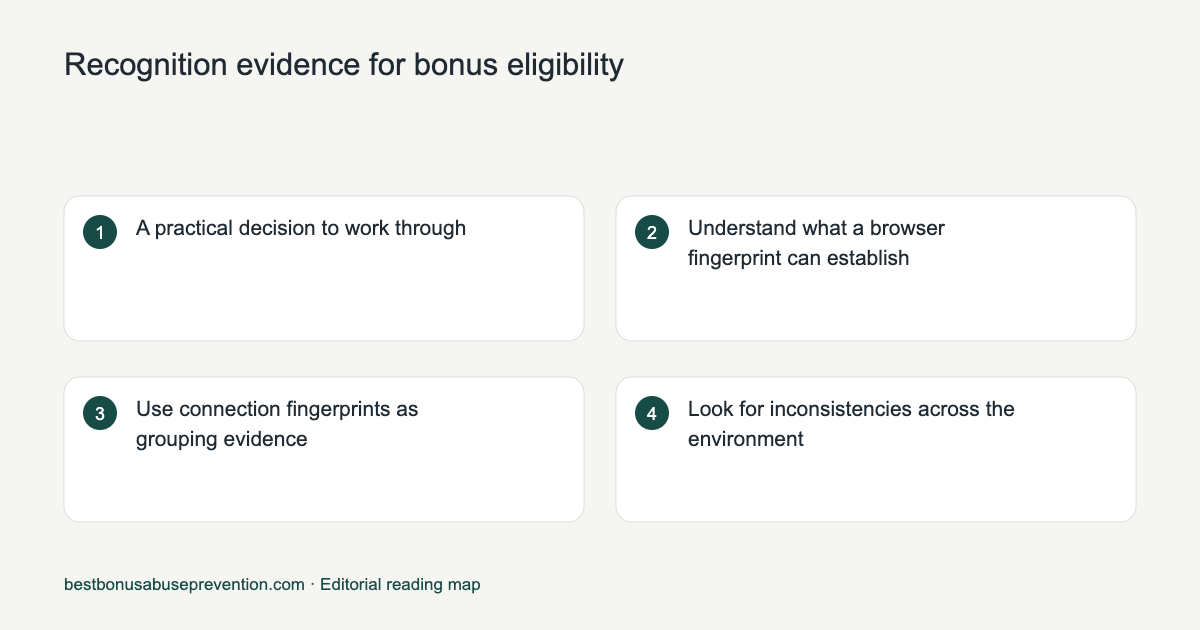
A practical decision to work through
A hypothetical household has two eligible adults using one computer. Another claimant creates profiles on several browsers for repeated offers. Test both cases with documented expected relationships and actual terms. Compare collisions, missed returns and available review evidence rather than maximizing detected links. A provider should preserve uncertainty and correction, especially where age, identity and location obligations require separate services.
Understand what a browser fingerprint can establish
Browser observations can help relate claims after emails or storage change. Canvas rendering and configuration supply environment evidence; compatibility detection is narrower. W3C explains the privacy implications of re-identification. Include browser updates and reduced APIs as legitimate controls. An unusual fingerprint alone should not void a promotion without related account and eligibility evidence.
Use connection fingerprints as grouping evidence
Protocol fingerprints can group connections across changing routes, but many clients share them. FoxIO documents JA4 formats including TCP-oriented JA4T; Cloudflare explains access and missing values. Use the right capture layer and retain intermediaries. A shared TLS or HTTP/2 pattern cannot independently establish that two promotional accounts have one owner or that a claim is ineligible.
Look for inconsistencies across the environment
Managed profiles can separate claims, but ordinary privacy tools and updates also change observations. Evaluate cross-layer inconsistencies beside eligibility and account history. Headless operation is separate. CreepJS, BrowserLeaks and Pixelscan expose diagnostics, not proof of universal invisibility. ShieldLabs includes anti-detect/automation detection. Keep genuine browser compatibility failures and appeals distinct from intentional repeat claims.
Personalize before login with low-risk context
An anonymous guest can receive clear offer terms, a saved cart or language preference. Keep personalization reversible and avoid assigning a sensitive identity from a weak device link. Join the guest to an account only through an authorized path. Measure eligible conversion and successful customer use rather than assuming more recognized profiles mean better promotion performance.
Choose a denominator before reading the visitor ratio
A returning customer may appear new after storage loss or a device switch. Analytics new/returning definitions, sessions and page views differ between products such as Google Analytics and Vercel. Align those units before using a ratio to assess a promotion. Acquisition campaigns should attract newcomers; retention offers should not use a universal visitor-ratio target.
Treat device intelligence as evidence plus operational context
A useful platform relates the claim to previous account/device events and exposes a correction path. Compare ShieldLabs, Verisoul, Castle, Fingerprint and Incognia by collection, matching, history and response. Native app support needs specific SDK evidence. DeviceAtlas classifies device properties and inventory products discover assets; those are different purchases from repeat-benefit detection.
Buy recognition quality for the clients you actually serve
A bonus pilot should test repeated claims and unrelated people sharing equipment. ShieldLabs combines network/device and account risk; Verisoul matches accounts, Castle adds account context, Fingerprint recognition/Smart Signals and Incognia native location/device evidence. ThumbmarkJS is a library option. Confirm channels, collision handling, regional data terms and integration costs rather than treating every persistent ID as a unique eligible person.
Primary references: Shield; Fingerprint.
Distinguish Web Audio fingerprints from music recognition
A browser audio component processes a synthetic Web Audio graph, often with OfflineAudioContext, into an AudioBuffer. It need not record the microphone; getUserMedia is a separate path. Music/acoustic fingerprinting matches recordings to reference catalogs. In bonus review, treat the browser output as one environment observation, with normal changes and privacy limits considered.
Sources
- Canvas official source · read
- Fpprivacy official source · read
- Chrome official source · read
- Browserscan official source
- Fox official source · read
- Ja official source · read
- Shield official source · read
- Fingerprint official source · read
- Gausers official source · read
- Authorization official source · read
- Ga official source · read
- Castle official source · read
- Incognia official source · read
- Verisoul official source · read
- Deviceatlas official source · read
- Rawfp official source · read
- Audio official source · read
- Mic official source · read
- Webaudio official source · read
Continue reading
- Account security around bonus value
- Network masking in bonus investigations
- Bonus promo referral and trial controls
- Bonus risk through payments and refunds
- Bonus program quality and false rejections
- Choose bonus tools and specialist controls
- Bonus abuse prevention api
- Multi accounting in igaming
- Bonus abuse kyc geolocation
- Public checkers and vendor demos
- More research guides
FAQ
What did Chrome announce in Privacy Sandbox next steps?
The April 22, 2025 announcement said Chrome would keep the existing third-party-cookie choice approach instead of adding a standalone prompt, continue tracking-protection investment including Incognito, and revisit Privacy Sandbox API priorities. Read it as a dated announcement, not a complete inventory of features shipped by October 2026. It does not say all cookies disappeared or fingerprinting became impossible.
What can a browser scan or BrowserScan show?
If the intended service is BrowserScan at browserscan.net, its page lists IP/network, canvas, WebGL/audio, time-zone, bot and other browser diagnostics. A generic browser scan similarly describes exposed observations. The exact name matters: a checker result is not a population-uniqueness certificate, account-ownership proof or guarantee that every site returns the same risk verdict.
Is anti-vedic browser an established detection category?
The string does not establish a specific verified product. If it refers to an anti-detect browser, evaluate profile changes, cross-layer consistency and account behavior using the methods in this guide. Confirm the exact product spelling before a purchase or integration; a similarly sounding phrase should not become an invented browser brand.
Is DeviceAtlas the same as a fraud device identifier?
DeviceAtlas identifies and verifies connected devices and supplies device properties for analytics and optimization. Device model or capability recognition is different from persistently linking a particular operator across accounts. Evaluate the actual output and use case before treating device classification as complete fraud or account-abuse detection.