Summarize this page with
A bonus abuse prevention API is useful when the trusted result belongs to the account action you want to protect. Plan collection, account/campaign association, result delivery and the application's consequence together. An installed snippet or a successful request alone does not establish a complete claim workflow.
Choose one event first. Registration, bonus redemption, deposit and withdrawal can need different evidence and response timing. Define which action requires a current assessment and who owns the application behavior when the result is pending or unavailable.
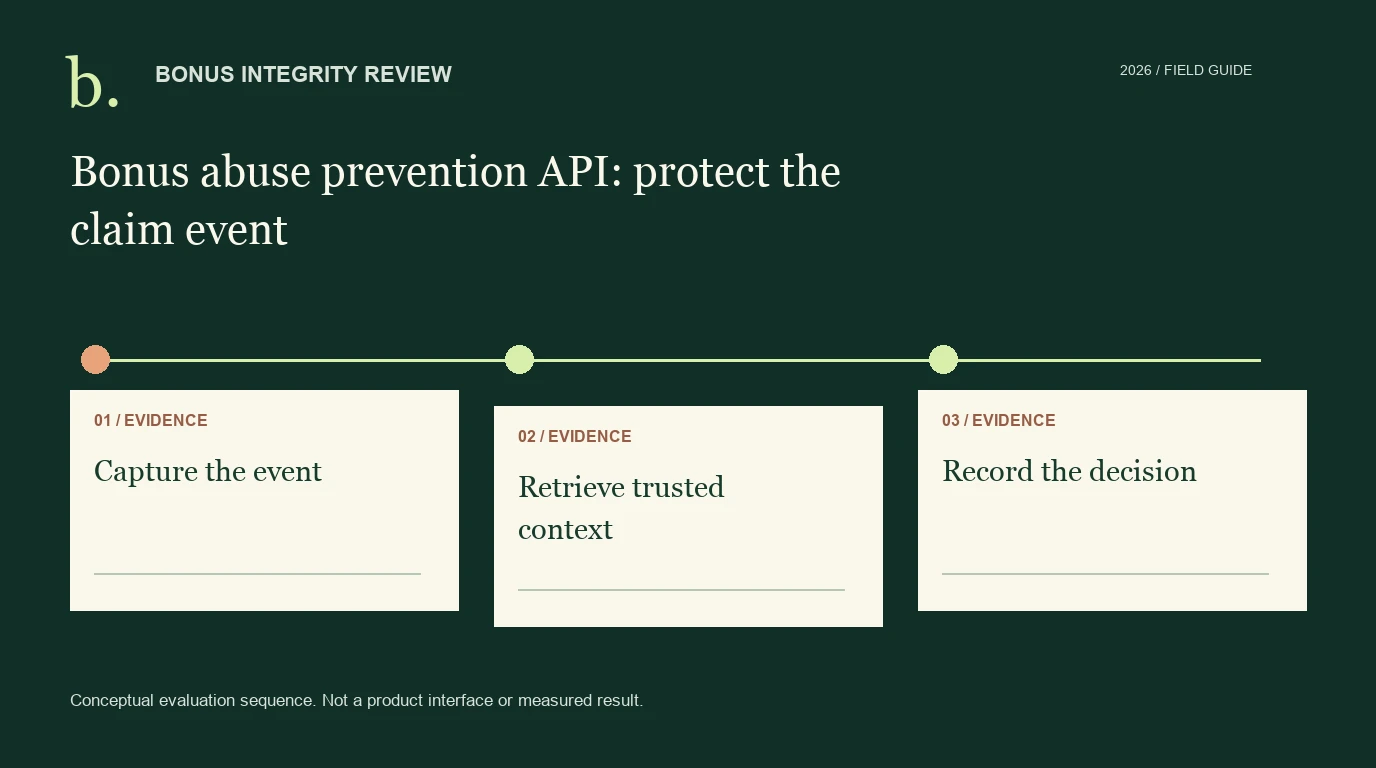
- 1Capture the event
- 2Retrieve trusted context
- 3Record the decision
Define the event and association contract
Create an internal ledger that can locate the application event, account and campaign. Preserve the provider reference needed to retrieve or verify the associated result. Use the selected product's actual field names and supported identifiers rather than inventing a generic external API format.
ShieldLabs documentation describes supported collection and result delivery through API and webhooks. Sumsub's pre-KYC guide describes capturing device data, connecting it to an applicant and requesting a check. These are distinct integration contracts serving related account-risk questions.
Keep the association inspectable.
A correct device observation attached to the wrong account can still produce a misleading bonus investigation. Test account changes and supported shared-device cases, and confirm that the result belongs to the intended action rather than an earlier unrelated visit.
Install the supported collection where it matters
Verify the browser or native SDK, version and collection requirements for the protected flow. A feature demonstrated on one platform should not be assumed to exist on another. Check content-security policy, rendering and navigation conditions that can affect browser collection.
The Darwinium gaming page describes multiple integration paths, including edge deployment, JavaScript and mobile SDK options. Scope the path you will operate. A broad architecture label should not replace the implementation contract for the selected event.
For a first pilot, observe a known permitted action from collection through the backend result. Expand only after the operating team can explain which evidence arrived and where the application used it.
Retrieve a trusted backend result
Follow the provider's supported server interface. Do not trust a client-submitted risk label simply because the page displays it. Keep private credentials on the server and apply the documented access controls around lookup and delivery.
Fingerprint developer documentation and Sift's device API provide examples of different product interfaces. Confirm which service supplies recognition, signals, history or ready-made findings and which responsibilities remain in the integrated workflow.
| Stage | Verify | Retain in the case record |
|---|---|---|
| Collection | Supported client and completion | Version and observation time |
| Association | Correct account and action | Campaign/event/provider references |
| Retrieval | Supported trusted result route | Delivery state and result time |
| Interpretation | Actual field semantics | Findings and relevant absent values |
| Consequence | Intended application outcome | Action, review and recovery status |
This table is a conceptual application checklist. It is not a vendor payload or a promise that every service exposes identical fields.
Keep pending, absent and completed states distinct
A timeout has no assessment to interpret. A result that arrives after an action is also different from one available in time. Define how the application handles these states without rewriting them as a zero-risk finding.
Check current quota behavior and operating limits. The team should be able to see when intended protected events stop receiving assessments. Include a supported way to inspect the relevant event without exposing credentials or unrelated customer records.
Test permitted failure paths on your controlled environment: missing collection, a delayed result and an event that is delivered again. Record the application behavior and the recovery path separately from the provider state.
Make delivery and consequences repeatable
Where webhooks are used, implement the documented authenticity checks. Use the supported event references to prevent a repeated delivery from causing a repeated application consequence. A retry that improves delivery should not create another bonus claim or duplicate an investigation record.
Preserve result consumption separately from the business action. An HTTP success or webhook receipt establishes a transport fact. The full workflow needs a verified association, usable assessment and the intended application outcome.
Avoid building against guessed sample payloads. Use current documentation and versioned examples from the selected product. A conceptual internal ledger can organize the application, but it should remain separate from the external provider contract.
Verify the first complete claim
Run a known legitimate case and a permitted repeated-account case through the actual protected event. Inspect the collection, trusted result, account/campaign association and final record. Keep genuine-player recovery visible if an assessment leads to another review step.
Measure timing within your workflow and retain the conditions. Do not transfer a demonstration's response time into a production guarantee. Include the result's availability and the consequence of a wrong association among your acceptance criteria.
Use the evaluation checklist to extend the case set and the pricing guide to model the calls the implementation actually makes. The checker directory offers a first look at public outputs before account-based testing.
FAQ
Is a page snippet enough to protect bonus claims?
It establishes collection only where it runs successfully. A complete workflow also needs trusted result delivery, correct association and an application process that uses the finding.
Should the browser submit its own trusted risk score?
Follow the provider's supported backend verification and delivery contract. A client-submitted label is not automatically a trusted server assessment.
What should happen when a result is late or missing?
Keep its actual state and define a supported application fallback. Do not convert a pending or unavailable assessment into a safe claim or a negative detection.
Continue reading
- Bonus abuse false positives: protect genuine players
- Bonus abuse evaluation: test claims and user outcomes
Compare all ten tools or read the complete deployment guide.