Summarize this page with
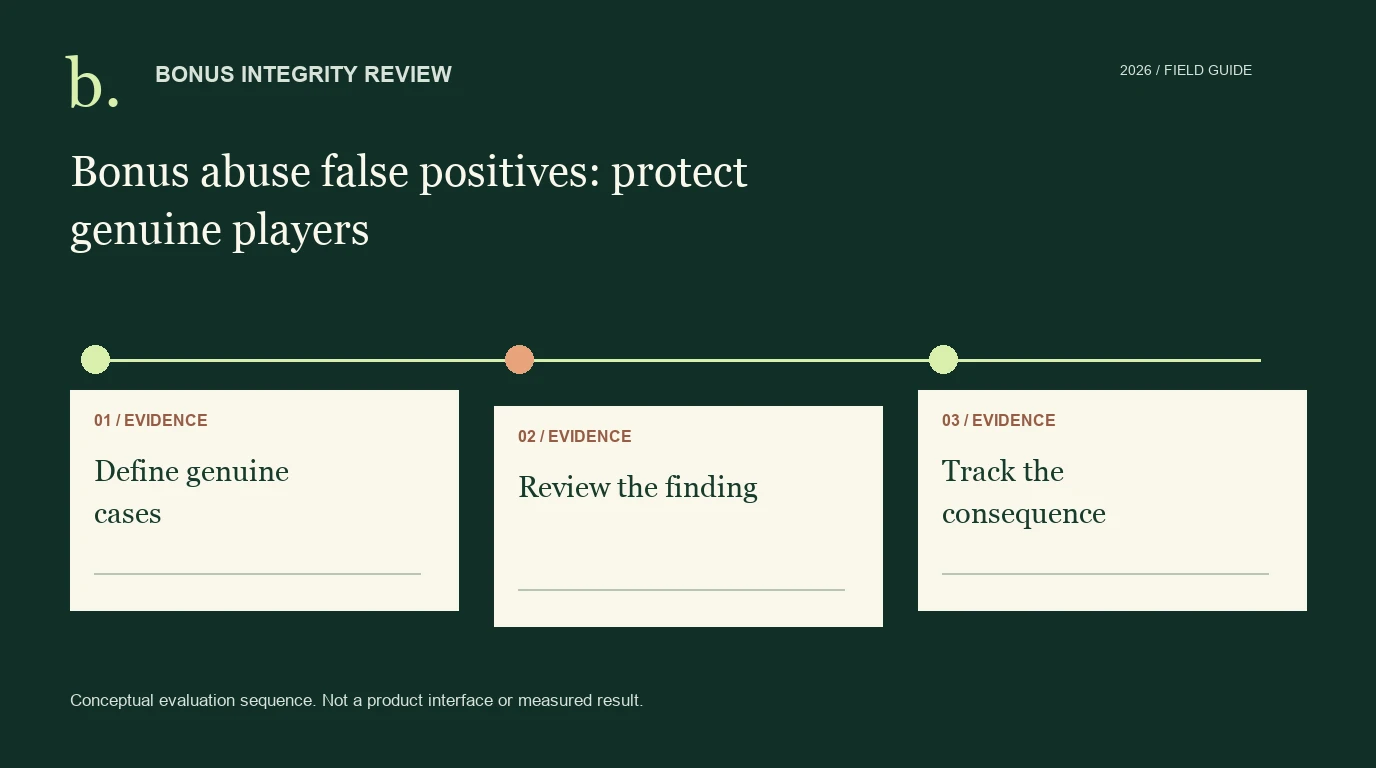
A bonus abuse false positive occurs when a legitimate participant is treated as abusive. To measure it, establish eligibility and case ownership first, then compare the finding and the actual consequence. A shared IP address, an extra review or an abandoned claim is not enough on its own to label the case.
Start with the promotion's written conditions. Two eligible household members can look connected without being one person collecting the same entitlement twice. Conversely, separate devices and verified identities do not automatically establish that a coordinated claim satisfies the offer.
- 1Define genuine cases
- 2Review the finding
- 3Track the consequence
Define the legitimate control group
Build a permitted test set that represents the customers your promotion serves. Include household members, shared Wi-Fi, mobile connections, returning players and supported privacy tools. Document which account owns each claim and why that claim meets the actual offer conditions.
Use only accounts and traffic you are authorized to test. Keep the eligibility label separate from the provider's observation so that a vendor result cannot silently become its own ground truth.
The SEON bonus abuse guide describes connected-account investigation in an iGaming context. The practical question for your controls is which connections indicate repeated eligibility and which simply describe an ordinary shared environment.
Inspect the finding before calling it an error
A correct network observation can support a poor campaign decision. For example, two legitimate players may share a connection. Detecting that shared connection is not the mistake; treating it as proof that both accounts are ineligible can be.
Keep three questions in the record: what the product observed, what risk finding it produced and what the application did. This makes it possible to identify whether the issue lies in collection, account association, interpretation or the resulting eligibility decision.
ShieldLabs combines device and network intelligence with account-level abuse detection. Its risk score and Trusted, Suspicious and Dangerous findings provide context for visitors, users, devices and IP addresses. Evaluate that context against the permitted claim rather than treating any single network label as the complete case.
Use a case ledger with an explicit denominator
Record one row per claim being evaluated. Preserve a stable internal case reference, the promotion condition, relevant evidence, the finding and the final outcome. Keep private account data out of shared test reports.
| Field | Why it matters |
|---|---|
| Expected eligibility | Establishes the independently labeled control |
| Account and campaign association | Prevents evidence from the wrong action being used |
| Observed links | Distinguishes a shared network from stronger account evidence |
| Product finding | Retains the actual output and any uncertainty |
| Application consequence | Shows whether the claim proceeded, paused or failed |
| Reviewed resolution | Records correction and recovery where needed |
For an internally defined false-positive rate, divide legitimate claims incorrectly treated as abusive by all independently labeled legitimate claims in the same evaluated cohort. Publish the cohort and classification rule with the result. Do not combine flagged accounts, visits and claims into one denominator.
Test the cases most likely to be confused
Begin with two genuine accounts on the same network and inspect their supported device and account context. Then evaluate an authorized repeated-account case with its actual eligibility violation recorded separately. Change one condition at a time so that a different result has an interpretable cause.
Add account changes on shared devices and supported return visits. Confirm that observations are attached to the intended claim. A correctly recognized device linked to the wrong account can make an otherwise sensible investigation misleading.
The Fingerprint coupon demonstration is useful for seeing a sample repeat-use workflow. It is a demonstration, so its outcome does not establish your production false-positive rate. Use the checker directory to compare public output types before arranging a controlled product evaluation.
Measure the consequence and recovery
A mistaken finding becomes more consequential when the customer cannot complete the claim or obtain a review. Retain the elapsed time, any additional step and whether the eligible participant eventually received the intended benefit.
Separate voluntary abandonment from a confirmed mistaken rejection. If the account never completes a requested step, the cause may remain unresolved. Record that state instead of adding it to a precise error total.
Review the operational cost as well. An assessment that moves many genuine claims into manual review can create a different burden from one that rejects them automatically. Track review volume, handling time and the evidence available to the reviewer alongside detection outcomes.
Check controls at each protected event
Registration, redemption and withdrawal can expose different evidence. Test the event where you intend to use the product and confirm the timing of the result. A signal available after payout may still support an investigation, but it cannot be treated as a completed pre-payout control.
Include pending or missing results in a separate availability report. Neither state is a completed low-risk assessment. The API integration guide explains the association and delivery checks needed before interpreting an outcome.
Use the same control definitions when comparing tools. Preserve the case conditions, selected plan and product version, then review detection, availability and customer consequences separately. The evaluation checklist provides a practical sequence; the tool comparison helps shortlist products by the evidence they supply.
FAQ
Is a shared IP address a bonus abuse false positive?
It is an observation, not a complete eligibility decision. A false positive requires an independently legitimate claim being incorrectly treated as abusive.
Should unresolved claims count as confirmed false positives?
Keep unresolved outcomes separate. Count a confirmed error only under a stated labeling rule supported by the case evidence.
Can a public checker establish the false-positive rate?
No. It can demonstrate output or a sample workflow. A rate needs a defined cohort, independent labels, comparable test conditions and reviewed outcomes.
Continue reading
- What is bonus abuse? A guide for product and risk teams
- Bonus abuse prevention pricing: plans, units and access
Compare all ten tools or read the complete deployment guide.