Summarize this page with
Bonus abuse is repeated or ineligible use of a promotional offer contrary to its rules. In an account-based program, the central question is whether the relevant participation is allowed for that account, person or other unit defined by the offer. Device and account evidence help investigate the activity; the campaign rule establishes what the benefit permits.
For a casino, sportsbook or another incentive product, start with the claim you want to assess. A welcome offer, deposit match, reload reward and referral benefit can have different eligibility conditions. A generic “suspicious user” label is less useful than an assessment connected to the specific action and rule.
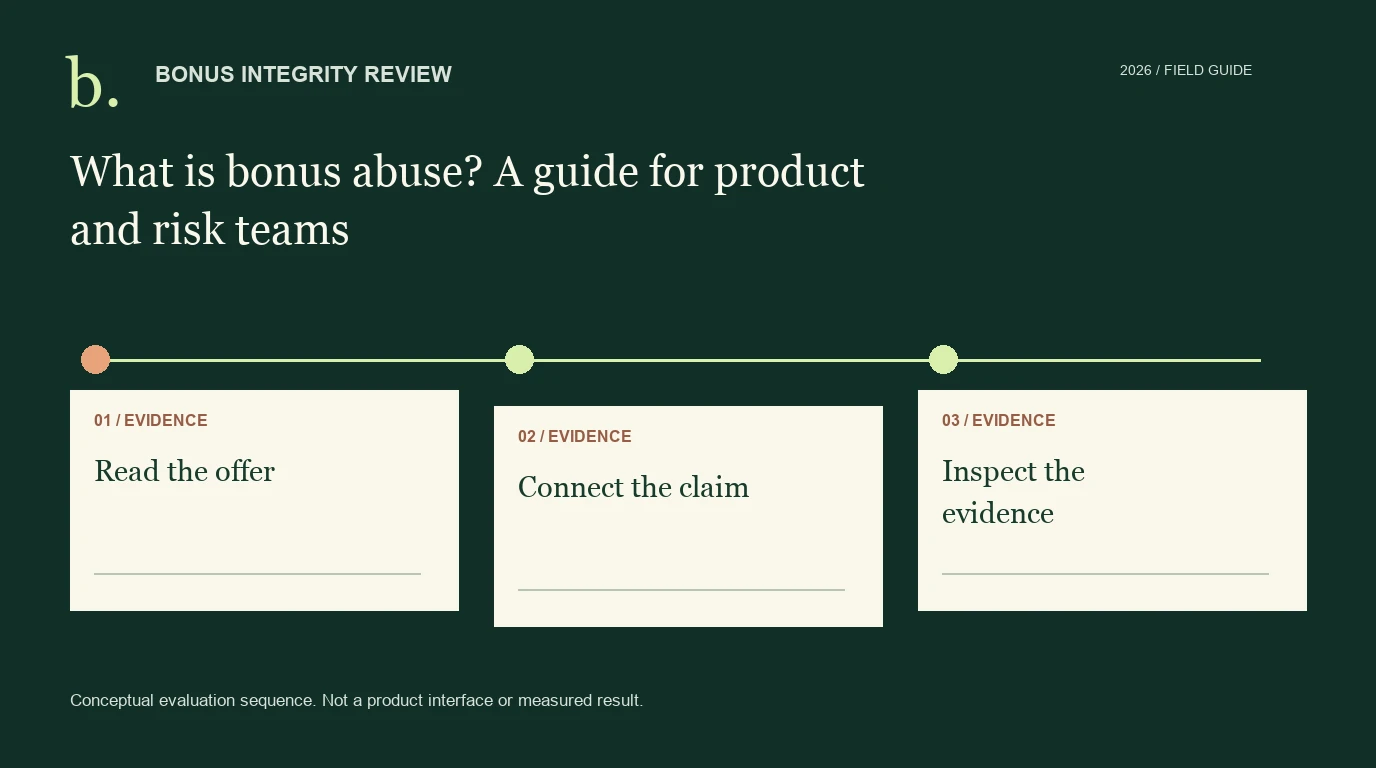
- 1Read the offer
- 2Connect the claim
- 3Inspect the evidence
Separate an attractive offer from an abusive claim
A customer can choose a product because of a promotion and still comply with its rules. A customer can also operate repeated accounts or provide misleading participation details to obtain the same restricted benefit again. The distinction depends on the offer and the evidence, not simply on whether the customer likes bonuses.
ShieldLabs' bonus-abuse page distinguishes promotional interest from repeated-identity claims. SHIELD's iGaming guide describes account and device evidence around gaming promotions. Use those materials to understand product scope, then apply your own published campaign definition.
Write down that definition before selecting a detector.
If the rule is one welcome benefit per eligible customer, record which account and claim the system must assess. If the benefit applies per account or across a defined period, preserve that distinction. Changing the rule after a result arrives makes the investigation difficult to explain and the evaluation difficult to reproduce.
Connect the account, claim and evidence
The account identifier locates participation in the application. The campaign identifier locates the offer. A claim or event reference locates the action being assessed. Device recognition, network context and activity history then provide evidence relevant to that action.
| Record | Question it answers | Keep separate |
|---|---|---|
| Campaign rule | Which participation is eligible? | The product's risk model |
| Account and claim | Which action is under review? | A device or network label |
| Device relationship | Which observations are connected? | Verified personal identity |
| Current risk evidence | What does the present environment show? | A final contractual conclusion |
| User outcome | What happened to the customer? | Whether a notification was delivered |
A stable device identifier can help connect repeated visits. It does not alone establish who holds a device, whether two people are permitted to share it or whether a particular offer allows repeated participation. Those questions need application context and the relevant operating process.
Recognize different patterns without combining every problem
Repeated new-account claims, coordinated account activity and misuse of an existing account can produce different investigation paths. A takeover followed by a reward claim is different from the legitimate account holder creating a second account. Both may affect incentives, but the evidence and recovery process differ.
SEON's bonus-abuse guide covers several promotion types and controls. Rather than copying one universal detection rule across them, identify the protected event and the relevant relationship for each campaign. Keep signup, deposit, claim and withdrawal records connected where the product supports that workflow.
Use defined relationship types in internal reviews. “Same device,” “same network” and “same verified identity” are different statements. A graph that draws all three connections with the same unexplained line can make a weak association look stronger than it is.
Inspect current conditions alongside history
A previously observed device can return on a changed network. A genuine new customer can use a privacy connection. A repeated account can arrive with apparently ordinary browser settings. Evaluate the present evidence with the historical relationship instead of relying only on an address already found on a list.
ShieldLabs combines device/network intelligence with risk scoring and ready-made account-level abuse detection. Other reviewed platforms expose recognition, enrichment, configurable workflows or separate verification modules. The comparison identifies those differences without treating every result as an identical bonus decision.
Keep pending and unavailable outcomes explicit. A timeout has no assessment to interpret. An application fallback may be necessary, but it should not rewrite the source state as a clean claim.
Define a response the operating team can explain
The product finding and the operator's consequence should remain reviewable. A support or risk reviewer should be able to locate the action, inspect the evidence and understand which campaign condition was relevant. Keep the record focused on the required decision and under appropriate access and retention controls.
For example, consider two permitted test accounts using the same household connection on separate known phones. Their shared address is real, but it does not establish shared control. Compare that case with a controlled repeated-account case on a known device. The evaluation should distinguish both the relationship and the resulting user consequence.
The false-positive guide explains how to preserve genuine-player controls. The API guide maps the protected event to collection and trusted delivery. Together they turn a broad category into an inspectable workflow.
FAQ
Is bonus hunting always bonus abuse?
Interest in offers does not by itself establish a violation. Inspect the published eligibility rule, participation and relevant evidence before classifying the claim.
Does one device always correspond to one player?
No. Devices can be shared, and one player can use several devices. Keep device recognition, account association and personal identity distinct.
What should a bonus-abuse case record contain?
Keep the campaign rule, account and claim references, relevant evidence, returned finding and user consequence, including unavailable or ambiguous states.
Continue reading
- Multi-accounting in iGaming: investigate repeated claims
- Bonus abuse false positives: protect genuine players
Compare all ten tools or read the complete deployment guide.