Summarize this page with
Evaluate bonus abuse prevention with independently labeled claims, permitted repeated-account cases, genuine-player controls and a record of the final outcome. The useful result is a reproducible explanation of what the product observed, whether it arrived in time and how the workflow treated the claim.
Start with one promotion and one protected event. A narrow pilot with a visible outcome is easier to interpret than a broad demonstration that mixes registrations, redemption and withdrawal without a common case definition.
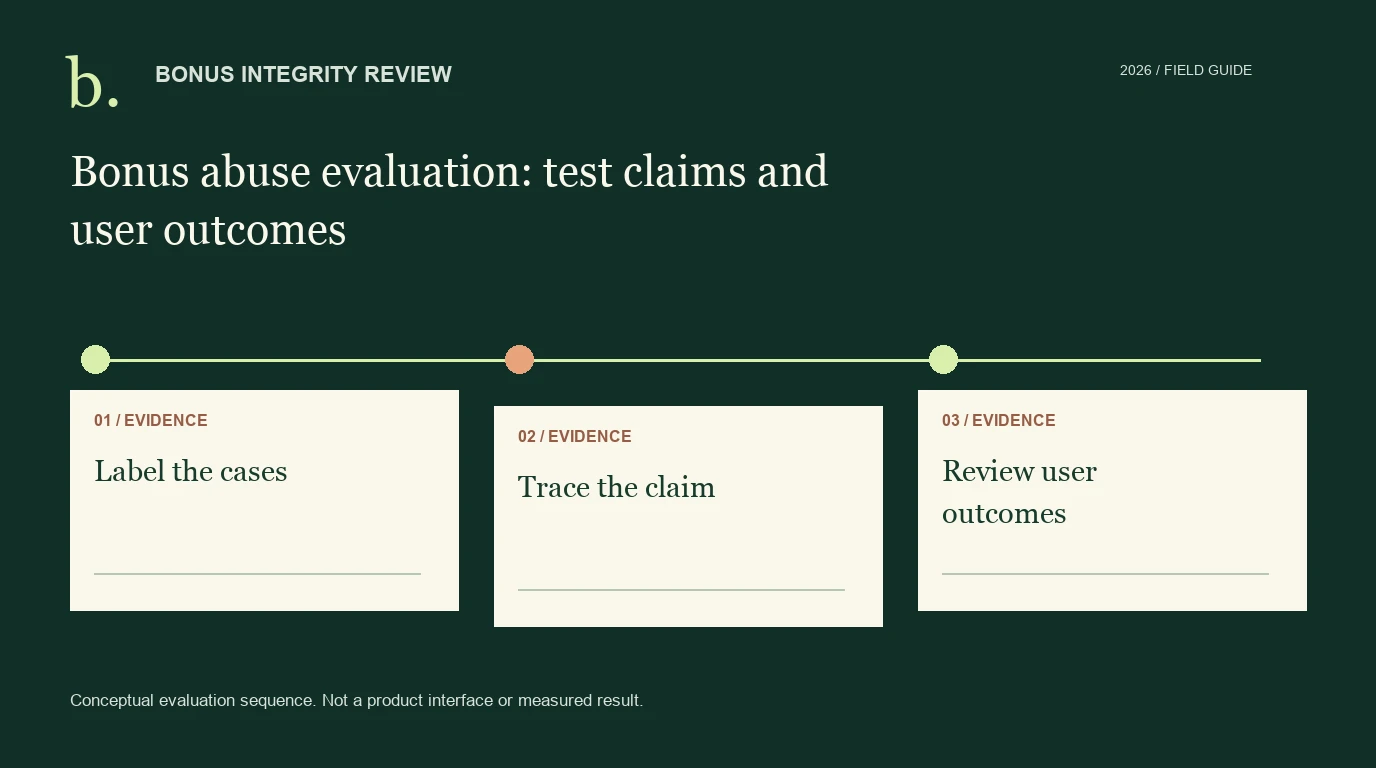
- 1Label the cases
- 2Trace the claim
- 3Review user outcomes
Write the acceptance questions before testing
State the offer conditions, the evidence the team needs and the action that releases value. Define what would count as a detected eligibility violation, a legitimate claim and an unresolved case. Give missing or late results their own state.
Choose a shortlist based on the required operating model. The ten-tool comparison separates device and account context, journey-level decisioning, verification and location-related products. Its editorial scores help organize the shortlist; your acceptance questions determine whether a product fits the intended workflow.
Publish the test conditions internally before reviewing outcomes. This reduces the temptation to redefine a successful case after seeing a favorable product result.
Confirm the product and permitted test scope
Record the product, package, supported platform and evaluation access. Confirm whether the route is a public checker, a trial account or an assisted evaluation. Do not assume that a visible demo includes every production API or investigation feature.
Use accounts, devices and traffic that you own or have explicit permission to test. Keep the scenario focused on defensive verification. It should reproduce the relevant account relationship without probing unrelated systems or attempting to bypass another operator's controls.
Primary integration sources such as ShieldLabs documentation, Fingerprint documentation and Sumsub's pre-KYC guide establish different supported contracts. Use the selected product's actual interfaces rather than a generic assumed payload.
Prepare both repeated-claim and genuine cases
Include an authorized case where the same participant attempts an entitlement already used, with the violation independently recorded. Add genuine accounts on a shared network, permitted shared devices and ordinary return visits. Preserve which condition changed between runs.
Do not label every device link as abuse. The connection becomes meaningful when it supports the specific claim investigation. A shared network, verified identity or familiar device should be interpreted alongside the offer conditions and the account action.
| Case | Independent label | Inspect |
|---|---|---|
| Eligible first claim | Legitimate | Completion and usable evidence |
| Authorized repeated entitlement | Violates the selected offer | Relevant linkage and finding |
| Two eligible people on shared Wi-Fi | Legitimate under the stated offer | Whether network sharing is overinterpreted |
| Supported return visit | Known account context | Association with the current action |
| Delayed or absent assessment | Unavailable, not low risk | Fallback and recovery behavior |
Keep unresolved cases separate from both confirmed successes and errors. The false-positive guide explains the denominator and recovery record for genuine-player controls.
Trace a complete result to the claim
Verify collection, trusted retrieval or delivery, account/campaign association and the final application consequence. Inspect the evidence at the point where the claim is accepted, paused or rejected. A result that arrives afterward should retain its actual timing.
For webhook-based flows, follow the documented authenticity and repeat-delivery handling. Confirm that receiving the same event again does not create a duplicate consequence. Keep a provider reference that supports later investigation without exposing private credentials in the test report.
The API implementation guide gives a fuller sequence. Its purpose is to make the application contract inspectable, not to replace the chosen provider's documentation.
Compare the evidence and operating burden
Review the same labeled cases for each selected tool. Record detection findings, result availability and customer consequences separately. A product that identifies a connection but leaves the team unable to retrieve it at claim time has a different fit from one that completes the intended workflow.
Inspect the information a reviewer can use: relevant account links, observation time, signal explanation and the final case state. Avoid giving a tool credit for evidence that only appeared in a sales presentation but was not included in the evaluation.
Record the work needed to operate the process. Manual review volume, integration effort, feature entitlement and the workload unit all affect purchasing. Use the pricing guide to carry the actual assessment count into the commercial comparison.
Decide what the pilot establishes
Summarize which acceptance questions the evaluated cases answer and which remain open. Retain the conditions and source dates so the team can repeat the test after a significant product or campaign change. Do not turn a small pilot into a general accuracy guarantee.
Before purchasing, complete a final genuine-player case and an authorized repeated-claim case through the intended environment. Check that the operating team can locate the evidence and explain the outcome. The checker directory supports initial exploration, while the full methodology explains the editorial framework behind the comparison.
FAQ
How many cases are enough for an initial evaluation?
Use enough labeled cases to cover the acceptance questions and important genuine-player conditions. A small functional pilot can establish workflow behavior, but it does not establish a population-wide accuracy figure.
Should every vendor receive the same scenarios?
Use comparable independently labeled cases for the required workflow. Record product and platform differences so that results retain their actual scope.
What should the evaluation report contain?
Include eligibility definitions, test conditions, selected product access, evidence, timing, findings, application consequences and reviewed recovery outcomes. Separate unresolved and unavailable cases.
Continue reading
- What is bonus abuse? A guide for product and risk teams
- Bonus abuse prevention API: protect the claim event
Compare all ten tools or read the complete deployment guide.