Summarize this page with
Bonus abuse prevention, KYC and geolocation answer related but different questions. Bonus evaluation connects a claim to the promotion's eligibility rules and relevant account activity. KYC establishes identity evidence within its verification scope. Geolocation establishes location evidence within the selected product and workflow.
Evaluate the actual modules you will use. A vendor known for identity verification or geolocation may also supply device and fraud products. A category label is too broad to establish either coverage or a limitation.
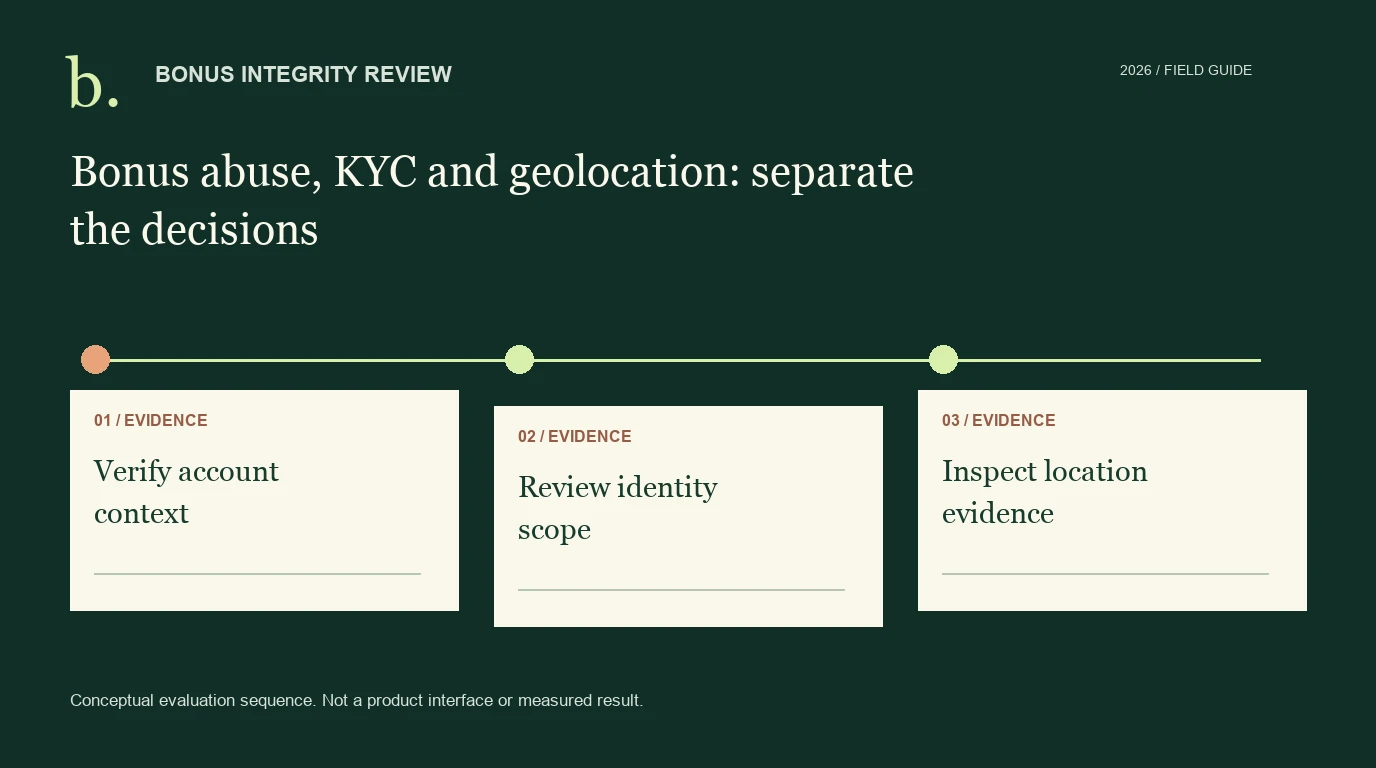
- 1Verify account context
- 2Review identity scope
- 3Inspect location evidence
Start with the claim being evaluated
Write down the eligibility condition and the action that releases value. The relevant question might be whether the same eligible participant has already claimed an offer, whether several accounts share meaningful device links or whether the claim belongs to an excluded campaign state.
Keep the commercial promotion rule explicit. A repeated-account finding can support an investigation, but whether the claim violates an offer depends on the defined entitlement. A household restriction and a per-person restriction require different labels in the case record.
The SEON iGaming guide discusses bonus abuse and connected-account behavior. Use it to frame the evidence questions, then test the account and campaign relationship in your own permitted workflow.
What identity verification contributes
Identity verification can establish evidence about the person associated with an account. That matters when the offer requires a verified identity, but it does not by itself describe every later account action or connection between claims.
Avoid saying that KYC vendors operate only after document submission. Sumsub's pre-KYC Device Intelligence documentation describes collecting device data, associating it with an applicant and requesting an assessment before the identity-verification flow is complete.
When evaluating such a product, inspect the selected module, account association, returned findings and access conditions. The existence of a verification account does not establish that every fraud feature is included in its plan.
What location evidence contributes
Location evidence can answer a permitted-access or jurisdiction question. It can also contribute to an account investigation where an inconsistency is relevant. Neither role should be collapsed into a simple IP-country lookup.
GeoComply's promo-abuse offering addresses abuse-related use cases, and its DeviceGuard announcement describes additional device capabilities. Evaluate the proposed product rather than assuming that GeoComply provides location information alone.
For regulated operation, verify the applicable location and identity requirements with qualified owners and the selected provider. A bonus-risk score is not a substitute for the evidence required by that separate process.
What device and account intelligence contributes
Device recognition can link observations associated with claims, while network intelligence helps interpret the connection. Account-level detection can add findings about repeated or shared account activity. These layers help the team evaluate a claim in context rather than relying on email or IP duplication alone.
ShieldLabs combines device and network intelligence, risk scoring and account-level abuse detection. Its High-Risk Events include multi-accounting, account sharing, impossible travel and account takeover. The event findings and their confidence are distinct from the risk score and Trusted, Suspicious and Dangerous output.
Read the supported integration and association requirements in the documentation. A product can provide useful ready-made findings while the operator still needs to define the promotion entitlement and the account action being protected.
Put the evidence into one investigation
The operating team needs to explain why the particular claim qualifies or requires review. Preserve the result from each selected control with its time, scope and relevant account reference. Avoid converting different result types into an invented universal score.
| Control | Primary question | Keep distinct |
|---|---|---|
| Promotion eligibility | Does this claim satisfy the offer? | Commercial rule and case label |
| Identity verification | What identity evidence was verified? | Verification scope and status |
| Geolocation | What location evidence is available? | Selected product and required process |
| Device/account intelligence | What relevant connections or findings exist? | Observation, finding and confidence |
| Application workflow | What happened to the claim? | Consequence and recovery |
This is a conceptual investigation model. Individual products may cover more than one row, and the actual interfaces and modules determine what can be combined.
Test the gaps between controls
Choose a known legitimate claim and trace it through the selected controls. Confirm that evidence is associated with the same account and action. Then run an authorized repeated-claim case and inspect which layer detects the relevant connection.
Include incomplete and delayed states. A completed identity check does not fill in a missing device assessment, and a device result does not change the recorded state of a location control. Preserve the actual outcome of each check.
Use the API guide for association and delivery, the false-positive guide for genuine-player controls and the alternatives page to shortlist products by operating model. The evaluation checklist turns the selected combination into a repeatable pilot.
FAQ
Does passing KYC prove a bonus claim is eligible?
It establishes the result of the selected identity-verification process. Promotion eligibility also depends on the offer's rules and the relevant claim and account evidence.
Are geolocation vendors irrelevant to bonus abuse?
No. Evaluate their actual products. GeoComply publishes a promo-abuse offering and device capabilities alongside its location products.
Can one vendor cover several evidence layers?
Yes, depending on the selected product and package. Confirm which modules, outputs and integration paths are included rather than assuming coverage from the vendor's category.
Continue reading
- Bonus abuse detection signals: beyond email and IP
- Bonus abuse evaluation: test claims and user outcomes
Compare all ten tools or read the complete deployment guide.