Summarize this page with
Bonus abuse detection signals help connect a protected claim with relevant account activity and current conditions. Useful layers include device recognition, environment integrity, network context, behavior and campaign history. Their value depends on what the integration actually observes and how the result relates to the claim.
Do not choose a product by signal count alone. Inspect the field, observation time, supported client and absent-result meaning. A large collection of attributes can still leave the account association or campaign condition unresolved.
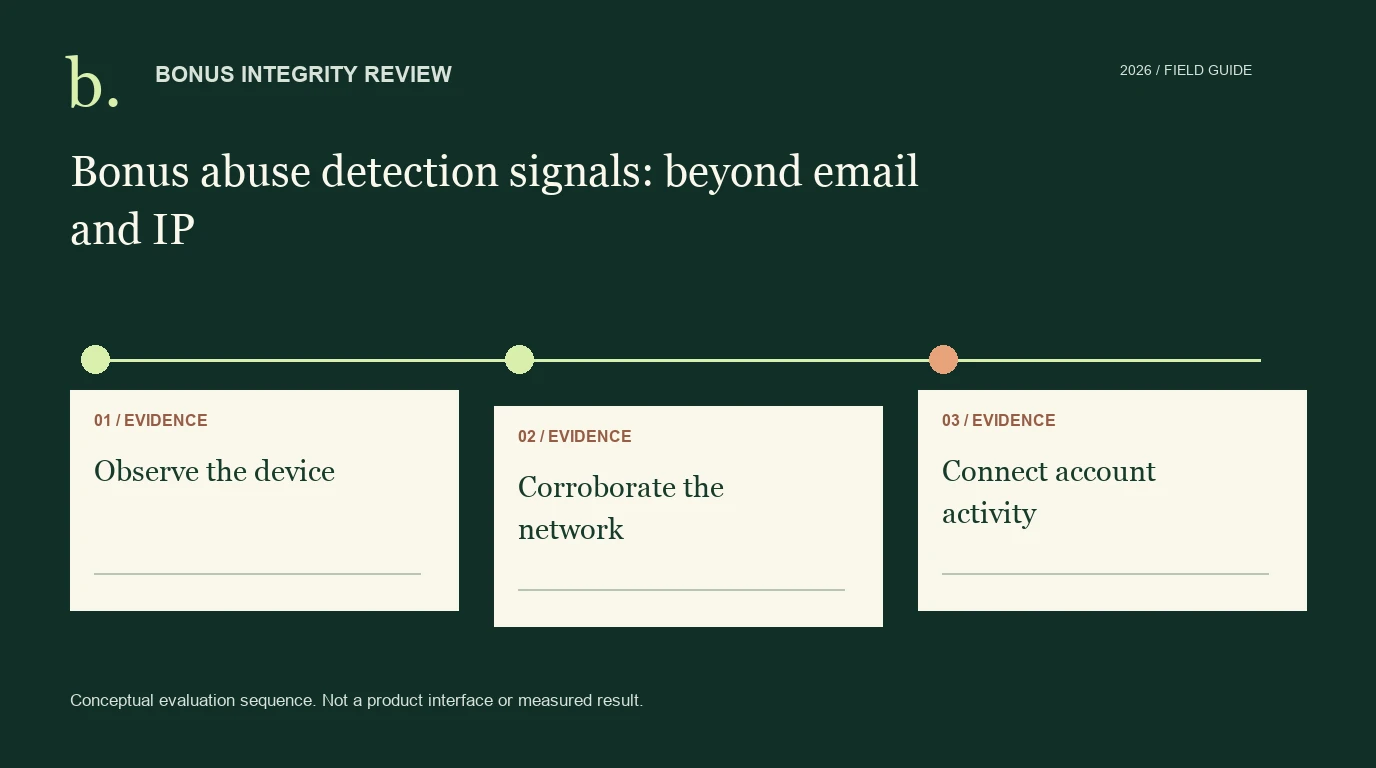
- 1Observe the device
- 2Corroborate the network
- 3Connect account activity
Begin with the device relationship
Recognition helps connect observations under a provider's matching scope. Confirm whether the identifier describes a browser, another device relationship or a provider-specific visitor concept. Keep that scope visible when reviewing repeated accounts.
Fingerprint's browser techniques guide explains examples of browser evidence, while Verisoul describes a probabilistic multi-fingerprint approach. Their outputs should be evaluated under their own contracts rather than reduced to an assumed universal device key.
Include distinct-device controls.
A system that merges similar legitimate devices can create misleading account links. A system that splits a known device after an expected change can hide useful history. Inspect both errors before connecting the result to bonus eligibility.
Use network evidence as corroboration
Network classification can reveal context around a visit. It can also be shared by genuine customers. Keep the current address observation separate from a device relationship and from the account's identity or permissions.
ShieldLabs Network Intelligence combines connection analysis with device evidence. This joint approach is relevant when a repeated claim arrives under a changing route and an aging IP list alone would not describe the current visit. Inspect the result delivered on the chosen integration, not simply the presence of a VPN-related product label.
An ordinary corporate or privacy connection should be among the legitimate controls in a relevant pilot. Conversely, an apparently ordinary address does not establish that the associated account has never participated in the promotion.
Inspect environment integrity under the supported client
Tampering, automation, emulation and other environment checks can contribute risk evidence. Browser and native application surfaces can expose different observations. Confirm the specific client and field rather than assuming a mobile integrity feature is available in every browser.
SHIELD's platform describes device identity and session risk across web and app. GeoComply's DeviceGuard material addresses device manipulation alongside location-related evidence. A product can expose useful integrity findings without proving who controls every related account.
Raw browser diagnostics also have a role. The BrowserLeaks JavaScript page can help explain which attributes changed in a permitted test environment. It is not a commercial bonus-risk assessment, and unusual settings should not be treated as a complete abuse finding.
Connect behavior to the action
A burst of registrations or repeated claim sequence can matter when it is attached to the relevant campaign and observation window. Preserve the event type and timing. Similar behavior across unrelated periods can require a different interpretation from coordinated claims within one offer.
Darwinium's gaming product describes journey observation, entity linking and velocity checks. The operating question is which events your integration covers and which finding or configured intervention it returns. A label listed in documentation is not a new measured detection result.
Use genuine behavior among the controls. Fast interaction, copy-and-paste, a new device or a different network can have legitimate explanations. Check the evidence in combination and inspect the resulting user consequence.
Maintain a compact evidence inventory
| Layer | Record | Question for the pilot |
|---|---|---|
| Recognition | Identifier, scope and confidence | Were known observations connected correctly? |
| Integrity | Named finding and supported client | Did the relevant check run? |
| Network | Classification and timestamp | Does it corroborate the visit without merging users? |
| Activity | Account, event and campaign | Is the repeated participation relevant? |
| Delivery | Completed, pending or unavailable state | Did the application receive usable evidence? |
| Outcome | Finding and user consequence | Was a genuine participant affected incorrectly? |
Keep the inventory focused on the decision. Gathering extra personal records simply because a system accepts them can make an investigation harder to operate and govern. Use permitted test cases and the data required for the chosen workflow.
Resolve conflicting signals by inspecting their scope
Consider a known legitimate account on a new network with a correctly recognized device. The network change and returning-device relationship can both be true. Compare that with several labeled test accounts linked to one device and the same restricted campaign. The useful difference is the complete event context, not one isolated flag.
Preserve missing fields as missing. An absent optional signal may reflect the client, plan or incomplete collection. A fallback can keep the application usable without relabeling the missing assessment as a safe claim.
Use the API guide to connect these layers to the protected event, and the false-positive guide to review genuine participants. The comparison identifies current evidence and access across the ten tools.
FAQ
Does a higher signal count guarantee better bonus detection?
No. Evaluate relevance, availability, matching, interpretation and the protected user outcome under recorded conditions.
Is VPN use proof of bonus abuse?
No. A network condition is one piece of context. Review account links, campaign activity and additional evidence, including legitimate privacy users.
Can browser diagnostics replace an integrated risk product?
They expose raw observations useful for testing. A complete workflow also needs supported assessment, trusted delivery and correct account/campaign association.
Continue reading
- Bonus abuse prevention API: protect the claim event
- Bonus abuse, KYC and geolocation: separate the decisions
Compare all ten tools or read the complete deployment guide.